The arrival of artificial intelligence is introducing three profound disruptions in hotel distribution and the direct channel:
#1 Conversational language. Many guests now prefer asking questions and receiving precise, multichannel answers instead of navigating long pages. Offering a fully conversational AI agent is increasingly important. Our AI agent Sarai meets this need.
NB: This is an article from mirai, one of our Expert Partners
Subscribe to our weekly newsletter and stay up to date
#2 Visibility in AI assistants powered by LLMs. Unlike Google Search, LLMs such as GPT, Gemini and Perplexity have not published official criteria for appearing organically in their results. Concepts like GEO or AIO are often mentioned, but the reality is that there is no clear or scientific methodology – everything comes from experimentation.
#3 Official content and agentic capabilities. The strategic challenge for hotels is twofold: delivering official, verified and structured content to the AI assistants operating on these LLMs, and enabling agentic capabilities so assistants can take actions on behalf of the guest, such as completing a booking. Both objectives converge in a new component of the hotel tech stack: an MCP server.
What is an MCP server
When discussing AI, it helps to distinguish two layers:
- An AI assistant (such as ChatGPT, Gemini or Claude) is the product the user interacts with: it manages the conversation, chooses which tools to use and shapes the final response.
- An LLM (Large Language Model) is the underlying engine (GPT-5.1, Gemini 3, Claude 4…), the mathematical model generating text and reasoning, but which on its own does not connect to external systems nor orchestrate anything.
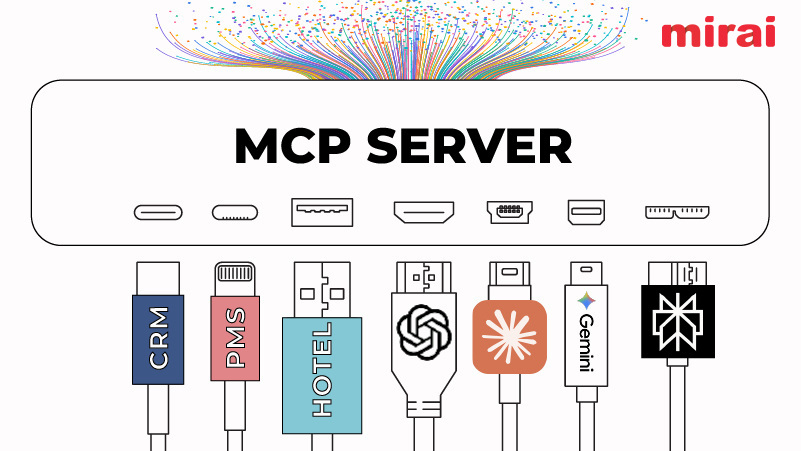
An MCP server (Model Context Protocol) is an interface that connects the hotel’s internal systems with AI assistants such as ChatGPT, Gemini, Claude or Perplexity. It provides hotel data in an orderly, structured and secure way: official content, rates, availability, policies, commercial rules, FAQs and, eventually, agentic reservation capabilities.
Although conceptually similar to an API, the key difference is that MCP functions as a universal standard – still consolidating – avoiding one-to-one integrations and acting like a “USB-C for AI.” It is the native way to connect with AI through its assistants.
Canonical database: ordered, accessible and structured data
Before thinking about MCP, hotels must solve a prior problem: disorder. Content is often scattered across websites, PDFs, internal documents, emails or even in employees’ memory. This generates errors, inconsistencies and unreliable answers.