
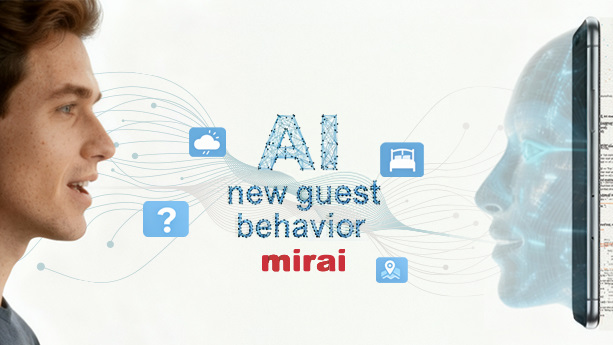
Think about your own habits: the way you search for information and get answers has already transformed. Artificial Intelligence (AI) is reshaping guest behavior at lightning speed.
NB: This is an article from mirai, one of our Expert Partners
Subscribe to our weekly newsletter and stay up to date
Ignoring this shift is risky. Yet most hotels still serve these new users the old way: with a conventional website – mostly informative and experiential – and a phone number.
That’s no longer enough. Hotels must adapt fast before it’s too late.
But first, let’s break down how this transformation is redefining guest expectations:
How guest behavior is changing with AI
- Immediacy. We’re getting more impatient than ever and expect direct answers rather than finding them ourselves. Hotel websites must be able to deliver clear responses instantly, without expecting visitors to browse endless pages.
- Conversational. Guests will expect to interact with you the same way they do with ChatGPT or Gemini: in a fully natural, conversational manner.
- Understanding and reasoning. When talking, we want to be understood the first time, without being asked to rephrase or explain again. Hotels must adapt to guests, not the other way around.
- Multilingual. Speaking only one or two languages is no longer enough. Guests expect seamless multilingual communication, regardless of their origin.
- Voice. Voice messaging – once just a WhatsApp feature – is rapidly becoming a new standard, accelerated by AI tools like ChatGPT and the widespread use of microphone buttons on mobile devices. While adoption is uneven, for many users speaking feels far more natural than typing, especially in the exploratory stage of a conversation. Hotels must be prepared for this shift.
- Context. Traditional chatbots fail because their lack of memory prevents them from delivering consistent, high-quality responses. True AI agents keep track of past questions, preferences and context. Once guests experience this, there’s no going back.
- Messaging interfaces. Many guests – especially younger generations – will bypass your website and head straight to WhatsApp, Instagram or AI-powered assistants if you make those channels available. The website remains vital for branding and transactions, but on its own it is no longer enough.
- Personalization. Who does not like to get personalized answers? Consumers in general want providers to recognize their preferences, past behavior, and intent, without asking them to repeat themselves.
- Proactivity. Guests don’t just want answers when they ask, they expect you to anticipate their needs and proactively offer solutions, just like a digital concierge.
- Trust & transparency. Guests demand accuracy and reliability. They will only trust AI if it provides clear, up-to-date and transparent information. Any mistake or generic response breaks confidence instantly.