
As artificial intelligence continues to reshape the hospitality distribution landscape, one question dominates conversations among hotel leaders: who will ultimately control the AI-driven guest journey?
Looking ahead to 2026, the answer is becoming increasingly clear.
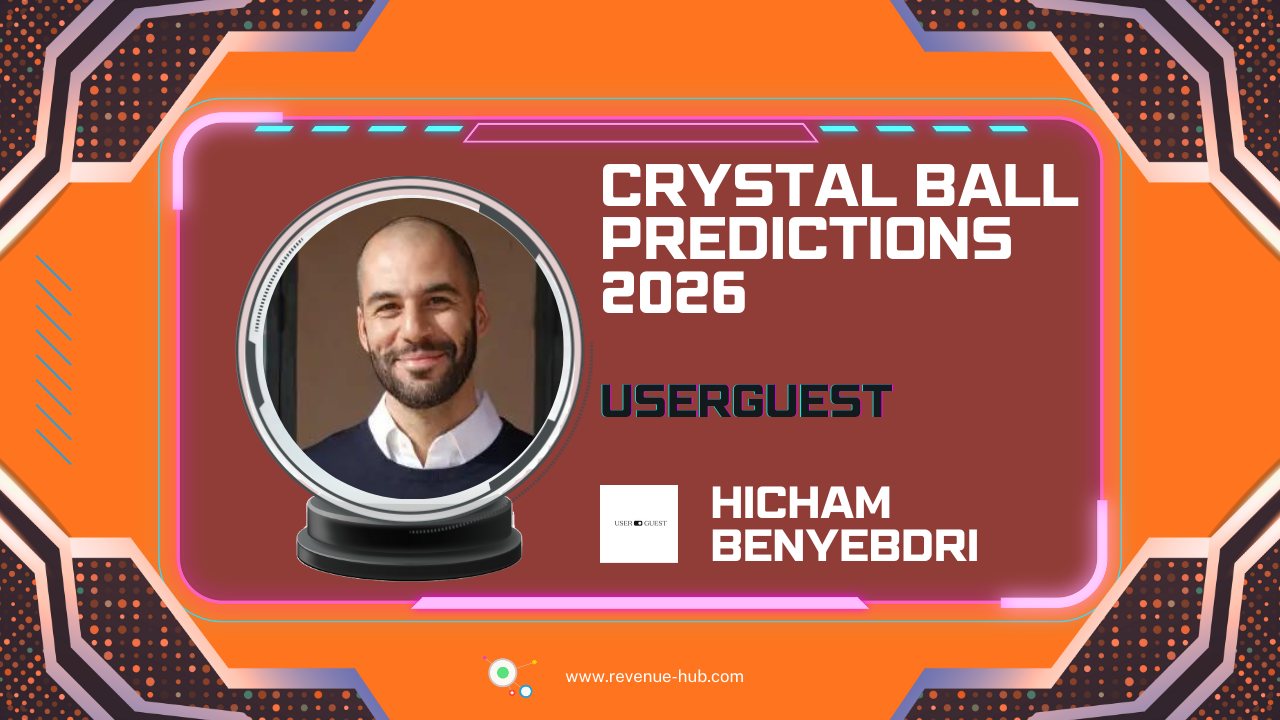
In a recent discussion as part of a 2026 “crystal ball” predictions series, Hicham Benyebdri of Userguest, one of our Expert Partners explained that while multiple players are competing for attention across inspiration, search, and booking, Google is positioning itself to dominate the transactional heart of hotel demand.
Here is the full interview and we have summarised some of the key points below.
Subscribe to our weekly newsletter and stay up to date
The AI race is often framed around headline names – ChatGPT, Claude, Gemini – but for hotels, the real issue is not who builds the smartest model. It is who controls demand at the moment of booking. That is where Google’s advantage becomes decisive.
Hotels already rely heavily on Google at the bottom of the funnel. Guests may be inspired on social media or OTAs, but when they are ready to book, they overwhelmingly turn to Google Search. With the rollout of AI-powered search experiences and Google’s AI Mode, that behavior is not changing – it is being reinforced. Search, AI-driven recommendations, Hotel Ads, pricing, availability, payment, and even stored guest data now sit within a single, familiar ecosystem.
This matters because trust and convenience drive conversion. Google already has both. Guests trust the platform, are comfortable entering payment details via Google Pay, and are accustomed to seeing transparent pricing comparisons. From a hotel perspective, this creates continuity rather than disruption. AI does not introduce a new channel – it amplifies an existing one.
By contrast, generative AI platforms like ChatGPT are likely to excel higher up the funnel. They will play an increasingly important role in inspiration, destination discovery, and shortlist creation. However, transaction is a different challenge. Booking a hotel requires breadth of choice, transparent pricing, and confidence that nothing has been missed. Limiting users to a narrow, algorithm-curated shortlist – potentially influenced by commissions – creates friction and skepticism.
We have seen this dynamic before. In metasearch, Google entered as a smaller player while TripAdvisor dominated. Over time, Google Hotel Ads captured the vast majority of market share by offering a clearer pricing model, deeper integration with search, and stronger monetization mechanics. The same pattern is now repeating in AI-driven search.
For hotels, this shift has significant implications. If Google continues to consolidate classic search, metasearch, and AI discovery into one platform, it simplifies distribution strategy. Instead of chasing every new AI tool, hotels can focus investment where it already performs: Google Ads. The platform is becoming more intelligent, more automated, and more connected – reducing operational complexity while expanding reach.
This does not mean OTAs disappear. They remain powerful, well-funded, and adaptive. However, AI is not necessarily strengthening their grip by default. If Google leads the AI transaction layer, hotels may actually gain more control – provided they continue to invest strategically and manage cost of acquisition with discipline.
The key takeaway for 2026 is focus. AI innovation is moving at unprecedented speed, and it is easy to be distracted by every new tool or announcement. Successful hotels will resist the noise and concentrate on outcomes: maximizing demand capture, improving efficiency, and protecting profitability. The platforms that help achieve those goals – not the loudest innovations – will ultimately win.
For now, all signs suggest that Google is best positioned to do exactly that.