
For years, chatbots have been the entry point to automated customer interaction. They were useful, predictable, and cost-effective. But they were also rigid, limited, and often frustrating. Today, a new generation of AI agents is emerging and they represent a clear evolution in how businesses and users will connect.
NB: This is an article from mirai, one of our Expert Partners
Subscribe to our weekly newsletter and stay up to date
AI is changing guest behavior and users’ expectations are already shifting dramatically. The rise of AI agents is the natural response to this new reality, moving hotels from simple automation to true intelligence.
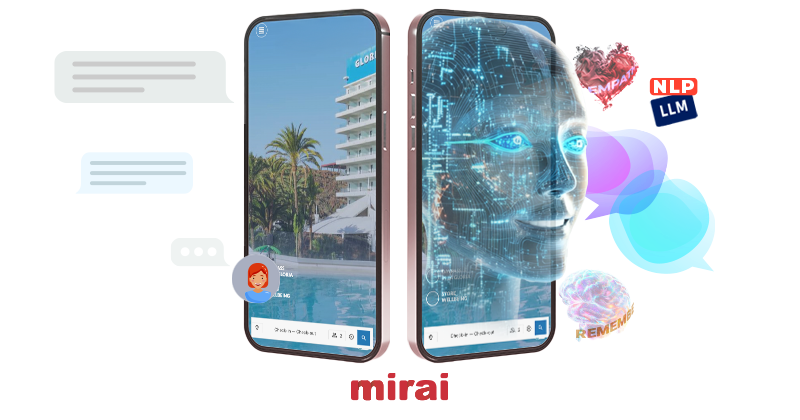
Traditional chatbots vs. AI agents
The differences between the two are not just incremental. They are transformational:
- Technology. Chatbots rely on fixed rules and decision trees. AI agents use new technology powered by advanced large language models (LLMs) and natural language processing (NLP) to understand and respond in context.
- Conversation. Where chatbots feel guided and mechanical, AI agents engage in fluid, natural dialogue.
- Understanding. Traditional systems depend on keywords. Agents grasp real meaning and nuance.
- Context. Chatbots treat every interaction as isolated. AI agents remember and build on past exchanges, making conversations coherent and personalized.
- Reasoning and memory. Chatbots don’t reason or remember. AI agents connect dots, recall history, and adapt over time.
- Voice. Chatbots were never designed for natural voice interactions. AI agents, however, are increasingly capable of holding real-time, human-like conversations through voice, opening the door to new use cases in customer service and beyond.
- Empathy. Chatbots deliver scripted replies with no emotional intelligence. AI agents can simulate empathy – modulating tone, adapting responses, and making users feel understood – an essential element for voice-based customer service.
- AI concierge. Chatbots were mostly limited to pre-stay questions or FAQs. AI agents, thanks to their contextual memory and ability to act, can also assist during the guest’s stay – handling service requests, providing personalized recommendations, or even acting as a digital concierge available 24/7.
- Scalability and experience. Traditional chatbots work with fixed scripts. When questions become more varied or complex, they fall short and give repetitive answers, which frustrates users. AI agents, on the other hand, understand context and adapt naturally, so they can handle more people without losing quality in the experience.
- Proactivity. Chatbots react to inputs. AI agents anticipate needs and proactively recommend.
- Learning and evolution. Chatbots are static. AI agents improve with use and are moving toward the role of true digital assistants.
Chatbots provided value at the time. They automated repetitive interactions and gave companies a first step into digital assistance. But today, their limits are evident, and they no longer meet customer expectations. AI agents represent the next stage of that evolution: more capable, empathetic, and integrated. The time for traditional chatbots has passed. The future belongs to AI agents.
In short, chatbots belong to the era of automation, while AI agents belong to the era of intelligence.