
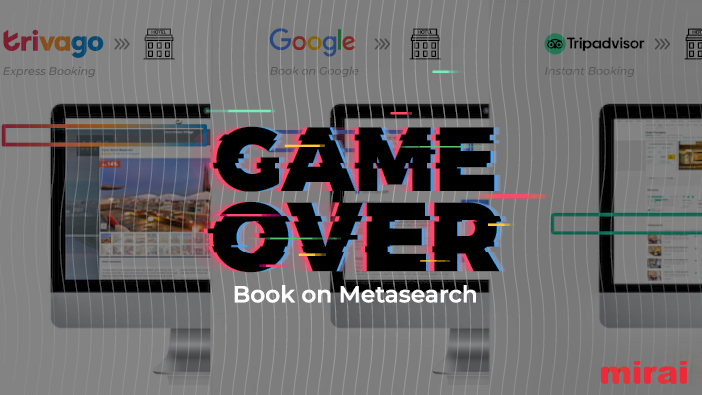
What began as the great revolution in hotel distribution a decade ago is now coming to an end. With the announcement of the closure of Tripadvisor Instant Booking (30 April 2026), the era of “Book on Metasearch” models is officially over. The “magic click” that was supposed to unseat OTAs has ended up quietly disappearing.
NB: This is an article from mirai, one of our Expert Partners
Subscribe to our weekly newsletter and stay up to date
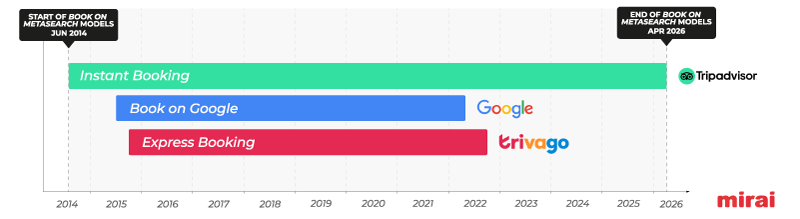
Chronology of a cycle coming to a close
The rise and fall of “Book on Metasearch” has been a learning process for the entire industry. Here is how the three giants attempted -and eventually abandoned- the transactional model:
What exactly were “Book on Metasearch” models?
To understand why they have disappeared, we must first remember what they promised. “Book on Metasearch” models (such as Book on Google, Tripadvisor Instant Booking or trivago Express Booking) were booking interfaces integrated directly into the metasearch engine.
Their main objective was to allow the user to complete their booking without leaving the platform. Although the inventory, price and final responsibility for the stay lay with the hotel or the OTA, the user experience (the look & feel) belonged to the metasearch engine.
Why did these models fail to succeed?
We can conclude that their decline was not due to a single factor, but rather a combination of operational, strategic and trust barriers. These are the main reasons:
- Lack of adoption: many hotels never felt comfortable “hiding” their brand behind the meta-interface, and OTAs did not want to feed a competitor that was trying to look too much like them. By not having the support of all connectivity partners and seeing how OTAs gradually withdrew, the model lost the critical mass and profitability necessary to sustain itself.
- “Merchant of Record” confusion: the user booked on the metasearch engine, but the charge was executed by the hotel or, occasionally, an OTA. This opacity generated critical insecurity: who to claim from if the room was not ready? Who issued the invoice? This lack of clarity regarding the real seller broke the basic pillar of any transaction: trust.