
Hotels love to say they “own the guest relationship.” It sounds good. It feels right. It’s been repeated enough that it’s almost accepted as fact. But here’s the uncomfortable truth:
OTAs might already know your guests better than you do.
NB: This is an article from three&six, one of our Expert Partners
Subscribe to our weekly newsletter and stay up to date
And with AI accelerating how they use that data, the gap is only getting wider.
So the real question isn’t hotel direct booking vs OTA.
It’s this:
Who actually understands the guest – and who’s best positioned to act on it?
Why OTAs Have the Advantage
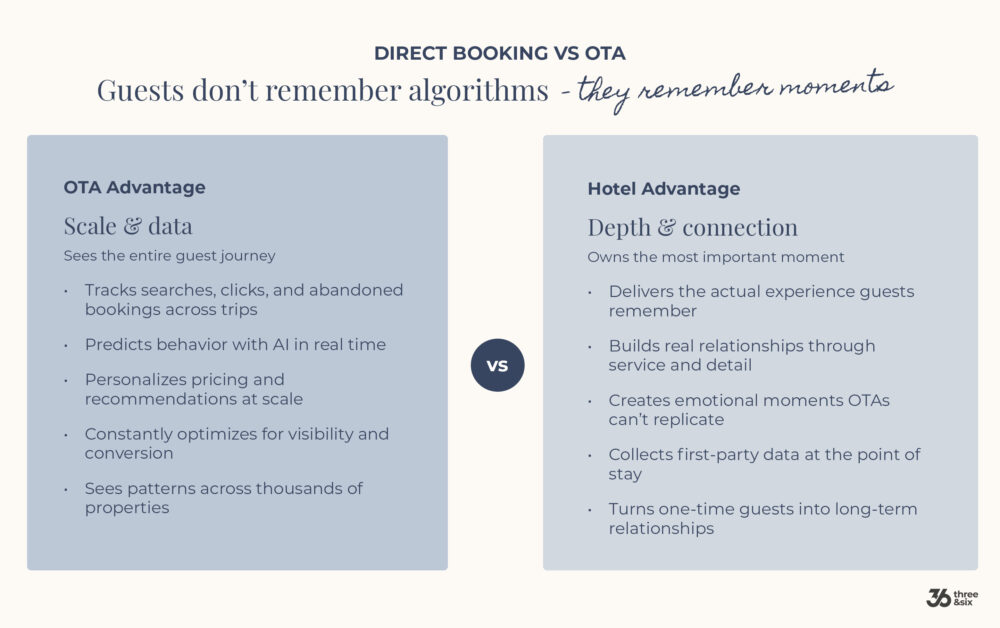
Before a guest ever arrives at your property, they’ve already told an OTA a lot about themselves.
They’ve searched, compared, filtered, clicked, abandoned, and returned. They’ve revealed preferences, price sensitivity, timing, and intent – often across multiple trips.
That’s the difference.
Hotels typically see a single stay.
OTAs see the entire journey.
This gives OTAs a powerful advantage. They’re not just reacting to behavior, they’re predicting it. With AI layered on top, they can personalize recommendations, pricing, and messaging in real time, based on patterns that go far beyond a single booking.
And because OTAs are built entirely around marketing, they’re constantly optimizing that visibility.
Hotels, on the other hand, are balancing marketing with operations, staffing, and service delivery. It’s no surprise that many fall behind in the data race.
The Myth of Owning the Guest Relationship
The idea that hotels fully “own” the guest relationship doesn’t always hold up.
In many cases, that relationship is short, transactional, and not consistently captured or used. Meanwhile, OTAs are continuously learning from every interaction – before, during, and after the stay.
That doesn’t mean hotels are at a disadvantage everywhere. It just means the advantage lies somewhere else.
Hotel Direct Booking vs OTA: What Hotels Actually Do Better
Here is where the narrative shifts.
While OTAs may know more about a guest, hotels have the opportunity to know the guest better.
That’s not about scale. It’s about depth.
Hotels operate at the most important moment in the journey: the stay itself. This is where real relationships are built – through service, attention to detail, and personal interaction.
Guests don’t remember algorithms. They remember moments.
- The front desk interaction felt genuine
- The bartender who remembered their order
- The small touches that made the stay feel personal
This is something OTAs can’t replicate.