
For hotel revenue managers around the world, the morning ritual has long looked the same: open a spreadsheet, run a pivot table, trace a finger across rows of data, and try to answer one fundamental question – what was my pickup? It works, but barely. And in an industry where speed, accuracy, and cross-team alignment can make or break commercial performance, “barely” is no longer good enough.
That is the problem Flyr Hospitality’s Insights platform was built to solve – and it represents a growing shift in how hotels worldwide are approaching data, decisions, and strategy.
We were delighted to be joined by Ashley Dehertogh, Product Manager for Insights at Flyr Hospitality, one of our Expert Partners
Here is the full interview and we have summarised some of the key points below.
Subscribe to our weekly newsletter and stay up to date
The Real Pain Points in Hotel Data Analytics
The challenges facing revenue directors, regional managers, and commercial teams are not unique to any one market. Whether a property is in London, Singapore, Dubai, or New York, the same friction points appear again and again. First, data is fragmented – spread across multiple property management systems with no standardised view. Second, turning that raw data into meaningful insight requires skills – dashboard-building, visualisation, analysis – that many hospitality professionals simply were not trained to perform. And third, even when insight is achieved, communicating it across teams remains a bottleneck.
A director of revenue might spend hours building an Excel model, only to present it to a general manager who wants a different cut of the data, or a sales manager asking follow-up questions the spreadsheet cannot answer on the fly. The insight is there – the ability to act on it quickly is not.
Self-Service BI: Flexibility Across Every Hotel Role
Flyr Hospitality Insights is designed as a self-service business intelligence tool – meaning users are not locked into a fixed set of reports or filters. Instead, the platform allows teams to build, customise, and interact with their data in ways that reflect their actual workflows.
For larger hotel groups, that might mean branded dashboards that mirror existing reporting structures, easing the transition from static spreadsheets to dynamic analysis. For smaller independents, it can mean hitting the ground running with pre-built templates. Either way, the platform meets users where they are – not where a software vendor assumes they should be.
AI That Asks the Right Questions Back
The most compelling element of Insights is its AI-powered dashboard assistant – a conversational layer built directly on top of the data. Rather than requiring users to think like a computer, it allows them to talk like a human. A revenue manager can ask, “What have been my corporate transient rate plan picks for this month at the flagship property?” and receive a structured, visual answer in seconds.
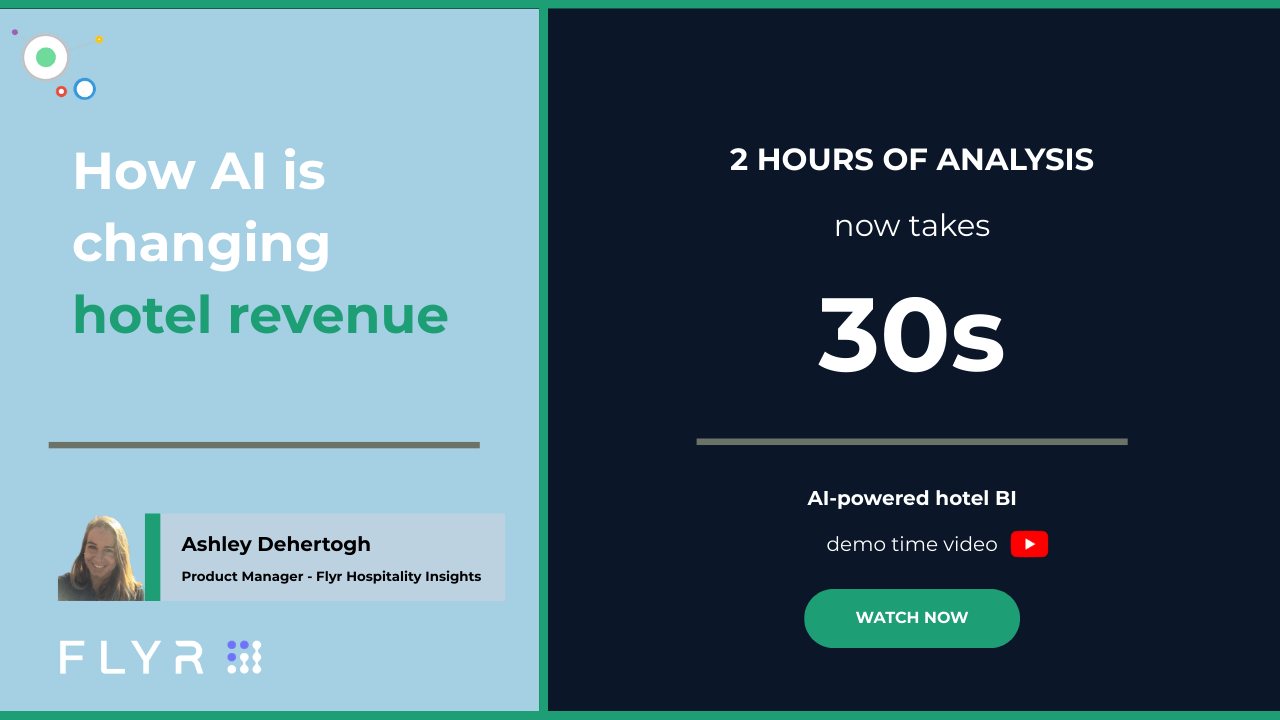
Crucially, the assistant does not just spit out answers – it asks clarifying questions when needed, mirroring the way a knowledgeable colleague might respond. That iterative, conversational approach allows follow-up queries to flow naturally, meaning a two-hour manual analysis can now take under a minute.
This is not AI for the sake of it. It is AI embedded precisely at the points of friction in a revenue manager’s day: translating analysis into insight, insight into stakeholder alignment, and alignment into evolving commercial strategy.
One Data Set, Many Conversations
One of the most powerful aspects of a centralised BI platform is that it allows different stakeholders – a GM, a revenue director, a BT manager, a corporate analyst – to interact with the same underlying data in ways that feel natural to each of them. The GM gets a high-level summary. The revenue director gets granular rate plan analysis. The regional director gets a portfolio view. No one is working from a different version of the truth.
That alignment is commercially significant. Too often, hotel teams arrive at strategic discussions having pulled data from different sources or run different analyses – and the meeting becomes about reconciling numbers rather than deciding on action. Shared, democratised data changes that dynamic entirely.
From Hype to Real-World Hotel Technology Value
The hospitality industry has not been short of AI promises in recent years. What Flyr Hospitality Insights demonstrates is that the value lies not in the technology itself, but in where and how it is deployed. Embedded at natural decision-making moments – morning pickup reviews, strategy validation sessions, portfolio reporting – it removes friction rather than adding novelty.
For hotel teams worldwide, the message is becoming clear: the era of the pivot table is not over, but its dominance is. The future of revenue management is interactive, conversational, and commercially aligned – and the tools to get there are already here.
Want to see Flyr Hospitality Insights in action? Reach out to request a personalised demo and discover how your team can move from data to decisions faster than ever before