

In hotel distribution, attention usually falls on the pricing strategy (“the what”), leaving the connectivity architecture (“the how”) in the background. However, the ability to maximize revenue directly depends on the technology that carries these prices.
NB: This is an article from mirai, one of our Expert Partners
Subscribe to our weekly newsletter and stay up to date
Technically, there are two standards for connecting the hotel ecosystem (RMS, PMS, Channel Manager and Booking Engine) with sales channels: PDP (Per Day Pricing) and OBP (Occupancy Based Pricing). Neither model is intrinsically superior; they are two different ways to achieve the same goal with different operational implications.
PDP (Per Day Pricing): rule-based pricing model
This model is the industry’s historical standard, designed to optimize operational efficiency and data transmission.
- What exactly is it? It is based on a primary pricing system: there is a lead rate (the base), and all other rates for different occupancies depend on it. These are not independent prices; they are automatically calculated based on the primary rate.
- How does it usually work? The hotel sends a single price (typically the Double room rate) from its system (PMS or Channel Manager). From that point, the Channel Manager usually handles the calculation: it applies a fixed rule (e.g., Base + €30 or Base – 10%) to automatically generate prices for singles, triples, or children. In some cases, this calculation rule may even be managed directly within the OTA’s extranet.
To understand the limitation of the PDP model regarding seasonality, it is necessary to observe how the large platforms operate.
1. In Channel Managers: the price per day (PDP) model is usually handled in two ways:
- Manual Management: total control, but slow management.
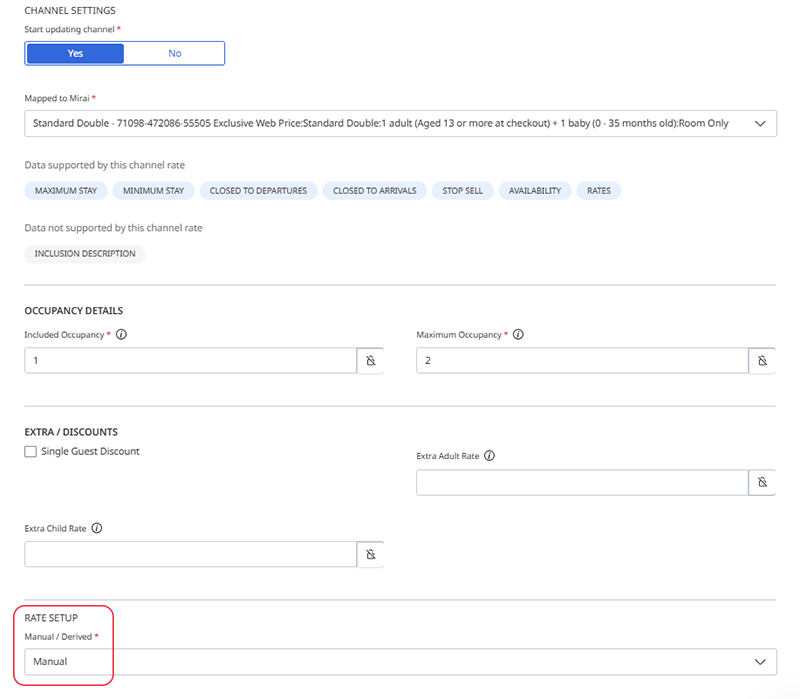
You decide the exact price for each occupancy (single, double, triple). It is highly precise, but if you change the primary price, the others do not update automatically, which results in a much higher workload.
- Derived Management: speed, but less flexibility.
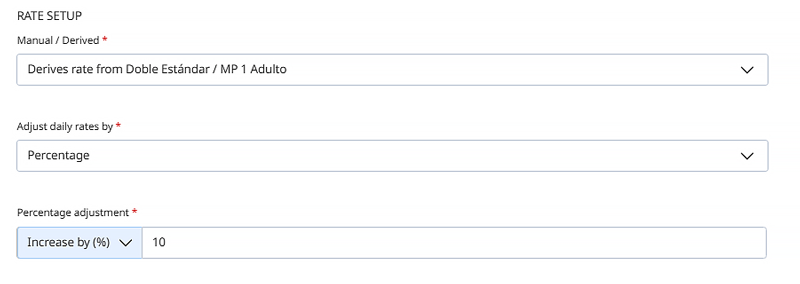
It is the most common option because it works automatically. You define a base price and the system calculates the rest following a fixed rule (for example: “add €30” or “add 10%”). The problem is that, being a rigid rule, it does not adapt well to changes in demand for each season.