
In the first part we analysed the difference between PDP and OBP: the “how and the why” of connectivity. Today we are going one step further: we will see “the what and the where”. Here you will discover how your pricing architecture decides your supplements, your ability to react to demand and why controlling your increments is key to maximising your revenue.
NB: This is an article from mirai, one of our Expert Partners
Subscribe to our weekly newsletter and stay up to date
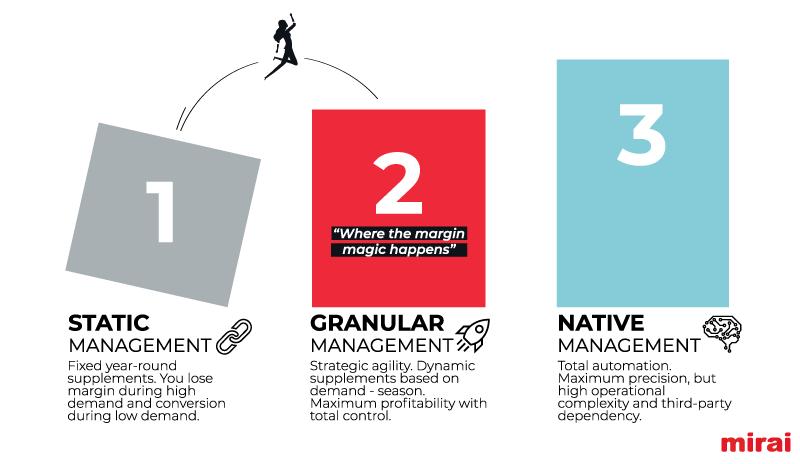
The 3 levels: who is in charge of your prices?
Not all hotels “move” their pricing in the same way. Depending on your technology, you will be at one level of agility or another. Identify where you are:
Level 1: the “same old supplement” (Static management)
This is the most basic model and the one used by most hotels: a base price per rate and a fixed rule, generally linear, for the rest of the occupancies.
- Where it happens: normally in the standard configuration of the channel manager, PMS or directly on the channel.
- How it works: “Triple = Base (Double price) + €30”. The supplement is identical in August (high demand) and in November (low demand).
- The risk: it is blind to demand.
- In high demand: you are too cheap → you lose ADR.
- In low demand: you are too expensive → it slows down conversion.
- The symptom: to escape this rigidity, the hotelier ends up creating duplicate rates (“Triple Summer”, “Children’s Promo”) as a solution to what the system does not do on its own.
Here, you do not decide your profitability: you decide it in advance and hope that demand behaves as you assumed.
Level 2: the “smart adjustment” (Granular management) – where additional profits are captured
This is where the real competitive advantage materialises. If your technology allows you to adapt to demand, you start beating the OTAs in technical advantage on your direct channel.
- Where it happens: in an advanced booking engine acting as a strategic corrector or in a PMS/channel manager with dynamic rules.
- How it works: you work with dynamic increments by understanding the context: “The child costs €10 in low season to stimulate family demand, but €50 in high season to maximise revenue”.
- The key advantage: you are surgical. Your direct channel reacts to demand with an agility that the OTA (generally anchored in Level 1 by operational design and scale) cannot match.
- The result: your website captures additional margin. Better conversion and a more coherent final price for the customer.
What is truly disruptive about this level is technological independence. Intelligence moves to the booking engine, which acts as a final strategic corrector and allows for the application of complex and granular pricing strategies without depending on the rigidity of the PMS or the channel manager.
This is the sweet spot of modern revenue: enough sophistication to capture real margin, without the extreme operational complexity of Level 3.