

Hotels are very good at measuring how revenue is generated. ADR, RevPAR, and channel production appear in almost every revenue conversation. But these metrics no longer tell the full story. Because between the moment the guest pays and the moment that revenue reaches your hotel’s bottom line, something significant happens.
NB: This is an article from Juyo Analytics, one of our Expert Partners
Subscribe to our weekly newsletter and stay up to date
A portion of that revenue disappears. Not because of pricing decisions or demand patterns, but because of how the booking was acquired.
Which raises a more revealing question:
What actually happens to revenue after the booking is made?
This question was at the center of our latest session, where we explored how distribution and acquisition costs reshape the revenue that actually reaches the bottom line.
The Revenue Journey No One Tracks
In most commercial reports, revenue appears as a single number. But in reality, revenue moves through several economic layers before it becomes profit.
Between the moment a guest pays and the moment that revenue reaches your hotel’s bottom line, several adjustments take place: markups are removed, commissions are deducted, and acquisition costs are applied.
The result is that the revenue reported isn’t always the revenue you actually keep.
Let’s put it in numbers:
| Stage | Revenue |
| Guest paid revenue | €1.308M |
| Hotel revenue (PMS / P&L) | €1.280M |
| After direct distribution costs | €1.165M |
| Net revenue after all acquisition costs | €1.028M |
At first glance, this hotel appears to have generated €1.28M in revenue.
But once acquisition costs are applied, the picture changes. From the €1.3M guests initially paid, roughly €270,000 disappears before reaching net revenue.
This means that, for every €1 the guest paid, the hotel kept roughly €0.79.
This is what some analytics teams call the sell-to-net funnel: the economic journey revenue takes from the moment a guest pays to the moment it reaches the hotel’s bottom line.
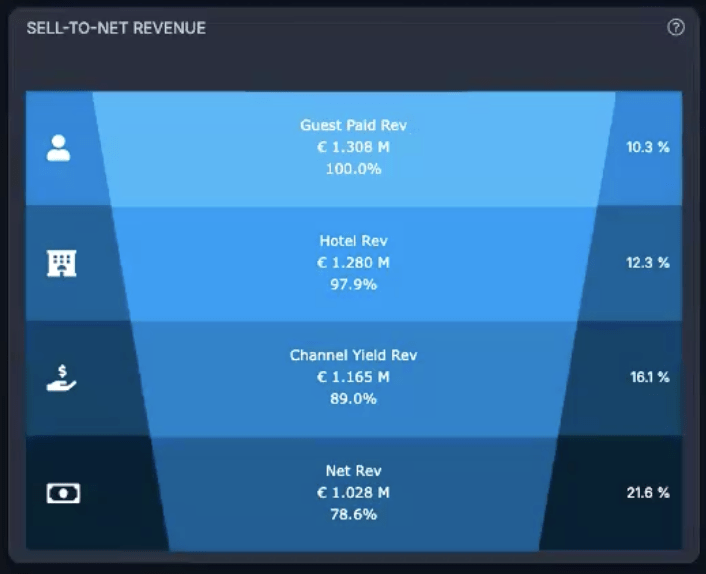
Once these costs are applied, revenue streams that initially look strong can compress significantly.
And this compression is rarely visible in traditional reporting – leading to many hotels still making decisions based on the top of the funnel rather than the bottom.