
The travel and hospitality technology landscape has spent the last couple of years caught up in a wave of superficial noise. We’ve been bombarded with conversational chatbots, standalone AI planning tools, and niche apps that promise a revolutionary new way to navigate information.
NB: This is an article from TRAVHOTECH
Subscribe to our weekly newsletter and stay up to date
But a fundamental structural truth remains completely missed by the mainstream tech commentary: consumers do not want to download a separate application when their native search engine already handles the task. Why open an isolated application drawer to map out a journey when the unified search container you live in natively surfaces, parses, and resolves that exact intent?
The massive overhauls unveiled at Google I/O 2026 – introducing the Gemini 3.5 Flash architecture, the deployment of Gemini Spark always-on autonomous agents, and a complete restructuring of the Search container – mark the definitive transition from passive keyword matching to an execution-first architecture. By pairing these agentic engines with the Universal Commerce Protocol (UCP) and a secure Universal Cart checkout infrastructure, Google is removing the friction layers that have historically fragmented digital commerce.
Key Insights: Google’s Agentic Shift toward Hospitality
- Google’s new Gemini 3.5 Flash architecture transforms the travel tech landscape by integrating AI and reducing reliance on traditional applications.
- The Marriott-Google AI direct booking integration allows travelers to book directly through Google AI, bypassing third-party OTAs.
- High-consideration travel purchases require consumer verification of experiences, prompting a need for direct pathways to brand.com.
- Hoteliers must adapt by dismantling data silos, rethinking pricing strategies, and digitizing their assets for visibility.
- Google aims to shorten the distance between consumers and service providers, fostering direct relationships in the hospitality industry.
This Google Agentic shift isn’t just a product upgrade. It is a structural milestone that completely redraws the distribution map for the hospitality industry.
2026 Data Canvas: AI Search & Hospitality Realities
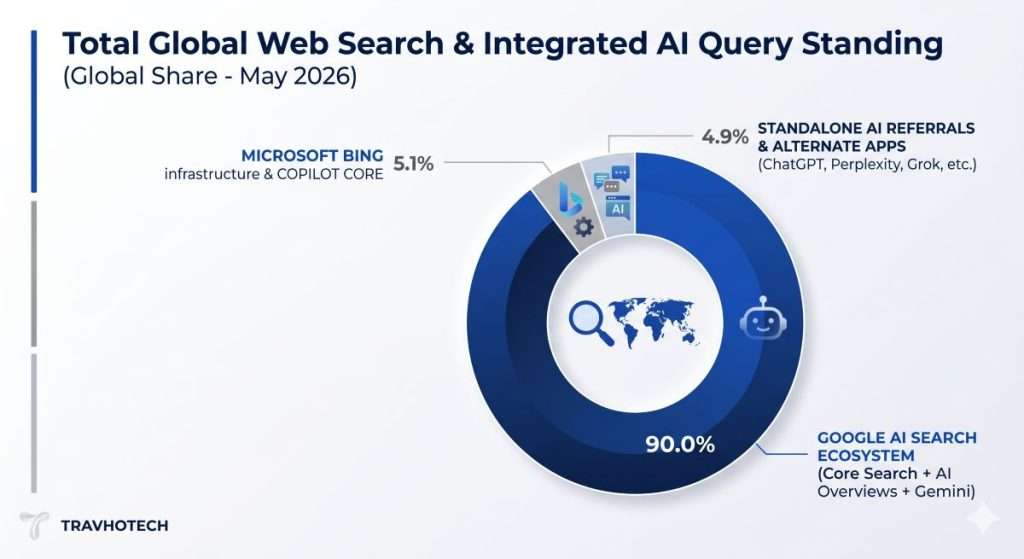
Visual Panel 1: Total Global Web Search & Integrated AI Query Standing
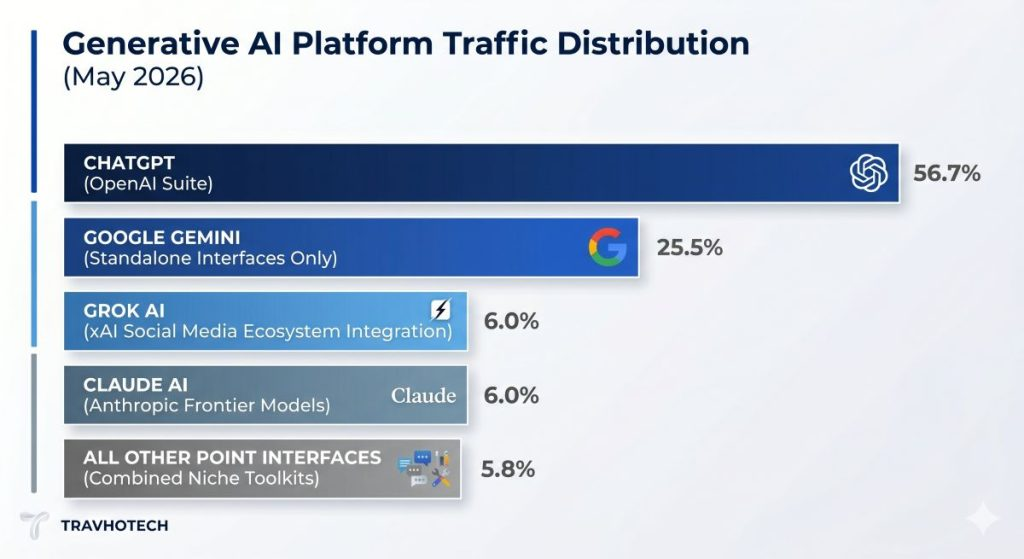
Visual Panel 2: Generative AI Web Traffic & Interface Market Share
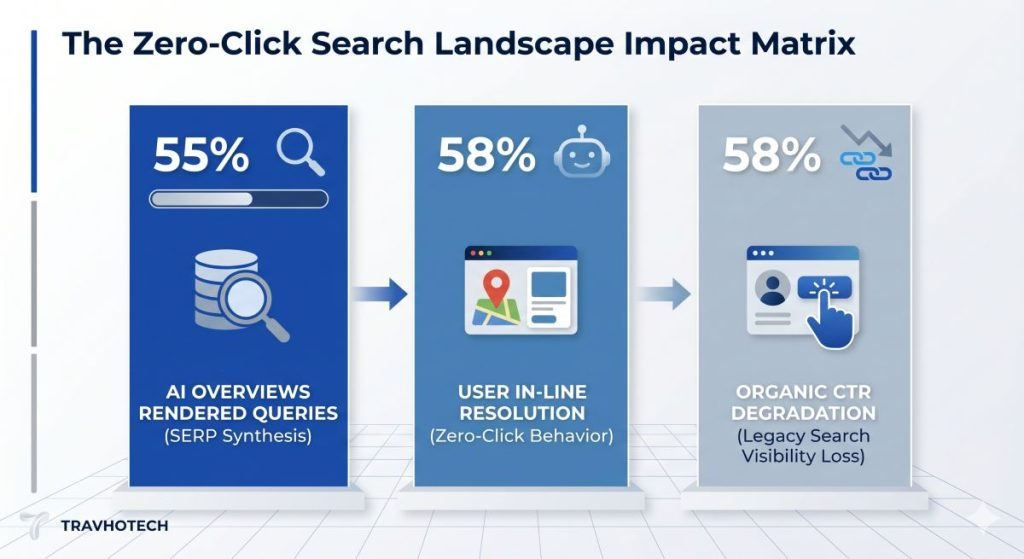
Visual Panel 3: The Zero-Click Search Landscape Impact
Ecosystem Gravity vs. Point Solutions
The architecture metrics clearly separate transactional distribution from conversational novelty. Standing alone, chat applications capture heavy text-based engagement. However, as the data layout details, platforms like Grok function strictly as high-velocity sandboxes nested inside social networks – they lack the transactional plumbing to threaten a global distribution network.
Google is an infrastructure layer. Because it functions as the mobile and desktop gateway for billions of consumers, its agentic environment doesn’t demand a forced change in human behavioral habits; it simply captures search intent natively.
The zero-click performance matrix defines the hidden risk: with 55% of queries triggering automated overviews, organic click-through rates to external web link arrays are down 58%. If your technology footprint relies entirely on old-school search discovery, you are becoming invisible.